
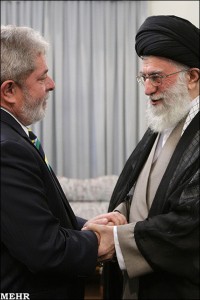
Brazil's President Lula with Iran's Supreme Leader Ali Khamenei
Brazil announced that despite its opposition to imposing sanctions on Iran, it has signed the UN resolution to impose sanctions on Iran and will adhere to its articles.
AFP reports that Celso Amorim, Brazil’s foreign minister said that the Brazilian president signed the UN resolution to impose sanctions on Iran because it has a tradition of “carrying out U.N. Security Council resolutions, including those we don’t agree with.”
Brazil and Turkey were the only two countries that voted against the fourth UN resolution in June of this year to impose sanctions on Iran. In May, the two countries brokered a deal with Iran in which Iran agreed to swap its low-enriched uranium with higher-enriched nuclear fuel in Turkish territory.
The US and its allies claimed the agreement was not enough and just a ploy by Iran to buy more time.
Washington suspects Iran of trying to build nuclear weapons but Iran has repeatedly denied this charge and maintains that its nuclear activities are all peaceful.
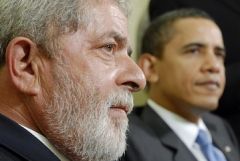
The Brazilian leader is disappointed with President Obama and his Latam policies
With less than five months in office and a public opinion support of 80%, President Lula da Silva considers his most important legacy the relation established between the presidency and the Brazilian people.
“The most important is the relation I established with society… with the people. All public policies which we implemented are the result of the participation of thousands of people from the towns, cities and states”, said Lula da Silva, 64, in an interview with the magazine IstoE.
“Government Palace is not only to receive princes”, said the former metal unions’ leader who was elected president in 2002 and repeated again four years later.
Regarding Brazil’s prospects, Lula da Silva said that “if we continue at this rate for six, seven years, we’ll be the fourth world economy”.
Asked about what he is planning for when he steps down next January, Lula da Silva said he is not interested in an international organization. (more…)
Brazilian President Luiz Inacio Lula da Silva highlighted on Monday the outcome of last week’s 39th Summit of the Southern Common Market in Argentina, which he said was the best in eight years.
He noted that the meeting eliminated a double trade tariff paid by all of the bloc’s member countries, which was hurting the region’s trade because of a “distortion,” he said.
The Brazilian president emphasized that the end of the tariff, known as the TEC, and the approval of a MERCOSUR customs code is creating space to consolidate “customs unity.”
He added that the MERCOSUR member countries had also approved the funding of nine projects worth $795 million to support regional development, and which will especially benefit the bloc’s smallest countries, Paraguay and Uruguay.
hr/rab/lch/ale
Construction begins on the Gibe III hydroelectric dam in southern Ethiopia. Photograph: Xan Rice for the Guardian
Dams in Brazil, Ethiopia and Malaysia will force people off land and destroy hunting grounds, says Survival International
Giant hydroelectric dams being built or planned in remote areas of Brazil, Ethiopia, Malaysia, Peru and Guyana will devastate tribal communities by forcing people off their land or destroying hunting and fishing grounds, according to a report by Survival International today.
The first global assessment of the impact of the dams on tribes suggests more than 300,000 indigenous people could be pushed towards economic ruin and, in the case of some isolated Brazilian groups, to extinction.
The dams are intended to provide much-needed,low-carbon electricity for burgeoning cities, but the report says tribal people living in their vicinity will gain little or nothing. Most of the power generated will be taken by large industries, it concludes. (more…)
A Nicaraguan smokes a joint of marijuana in a poor district of the port of El Bluff. Photograph: Oswaldo Rivas/REUTERS
Mexico’s president Felipe Caldéron is the latest Latin leader to call for a debate on drugs legalisation. And in the US, liberals and right-wing libertarians are pressing for an end to prohibition. Forty years after President Nixon launched the ‘war on drugs’ there is a growing momentum to abandon the fight
The birthday fiesta was in full swing at 1.30am when five SUVs pulled up outside the house. Figures spilled from the vehicles and ran towards the lights. They burst into the house and levelled AK-47s. “Kill them all!” A shouted instruction, only three words, and the slaughter began.
Gunfire and screams drowned the music. Some victims were cut down immediately, others were caught as they tried to escape. By the time the killers left there were 17 corpses, 18 wounded and 200 shell casings. Among the dead was the birthday guest of honour, a man local media named only as Mota, Mexican slang for marijuana.
The atrocity last month in Torreón, an industrial city in the northern state of Coahuila, came amid headlines shocking even by the standards of Mexico’s drug war. A sophisticated car bomb of a type never before seen in the country; a popular gubernatorial candidate gunned down in the highest-level political murder; and then last week the release of official figures putting the number of drug war-related murders at 28,000. (more…)