

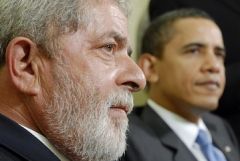
The Brazilian leader is disappointed with President Obama and his Latam policies
With less than five months in office and a public opinion support of 80%, President Lula da Silva considers his most important legacy the relation established between the presidency and the Brazilian people.
“The most important is the relation I established with society… with the people. All public policies which we implemented are the result of the participation of thousands of people from the towns, cities and states”, said Lula da Silva, 64, in an interview with the magazine IstoE.
“Government Palace is not only to receive princes”, said the former metal unions’ leader who was elected president in 2002 and repeated again four years later.
Regarding Brazil’s prospects, Lula da Silva said that “if we continue at this rate for six, seven years, we’ll be the fourth world economy”.
Asked about what he is planning for when he steps down next January, Lula da Silva said he is not interested in an international organization.
“I would reject it”, he said. But he admitted he would like “to socialize” sharing social policies implemented in Brazil in other countries of Latinamerica and Africa.
In related news his foreign affairs advisor Marco Aurelio García said Lula da Silva was disappointed with his US peer Barack Obama.
“Lula is a bit disappointed because he has a great consideration for Obama; there are great expectations about him and his policies” said Marco Aurelio pointing out to several dissenting issues with the US administration.
One of those issues which did not please Brazil was the US position of further imposing sanctions on Iran, ignoring a signed agreement reached with Turkey and Teheran for uranium enrichment outside Iranian territory.
“We proposed a way out, which was ignored by the US in a non polite, almost aggressive and non friendly manner”, said Lula da Silva’s advisor.
Furthermore since the arrival of President Obama in January 2009 there have been “few changes” in the US policy towards Latinamerica.
Another issue which distanced Brasilia from Washington was the Honduras coup of June 2009.
“The US should have adopted a stronger stand, more energetic” with those responsible for the coup that ousted elected President Manuel Zelaya, said Gracía in an interview with the daily Estado de Sao Paulo.

Leave a Reply