
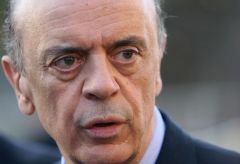
The candidate also criticized Lula da Silva’s close links with dictators
Brazil’s presidential opposition candidate Jose Serra promised substantial changes to the country’s foreign policy if elected next Sunday. He specifically mentioned Brazil’s lobbying for a seat at the UN Security Council, the functioning of Mercosur and relations with Cuba and Iran.
“Mercosur impedes Brazil from advancing in free trade agreements with third parties because any unilateral negotiation is conditioned to the other members”, said Serra who also was ironic about the recent agreement reached with Israel.
“If we are elected, we are going to implement a trade policy which Brazil lacks. There have been too many trips overseas. The world reached many trade agreements in the last eight years, and Brazil only managed a very small one with Israel”, added the opposition candidate who is several points behind the ruling coalition candidate Dilma Rousseff in public opinion polls.
“This government only managed a limited agreement with Israel that is not even worth the Israeli oranges since they come from settlements that are considered disputed Palestinian territory. What a success”, said Serra ironically.
Regarding relations with Cuba and Iran, the national broadcaster O’Globo quoted Serra saying that “I survived thanks to groups who fought for human rights when I was arrested in Chile following the military coup of Pinochet in 1973. I personally value and have great respect for human rights and those who are committed to them. As a country you can have relations with a nation ruled by a dictator, but you can be sure I will not express admiration or cultivate friendship with a dictator”.
Brazilian president Lula da Silva has been severely criticized for his close relations sometimes described in the local press as “cosy” with Cuba’s Fidel Castro and Iran’s Mahmoud Ahmadinejad.
Finally Serra criticized the current Lula da Silva administration approach and strategy to have the UN reviewed and a permanent seat for Brazil in the Security Council. (more…)
about Brazil, Paraíba and João Pessoa

Brazil's presidential candidate for the Workers' Party Dilma Rousseff delivers a speech.
In a week’s time, Brazil’s 136 million voters will decide their next president: the former right-hand woman of outgoing President Luiz Inacio Lula da Silva, or an efficient ex-governor of Sao Paulo state.
The polls point to a likely victory for Lula’s choice: Dilma Rousseff, his 62-year-old former chief minister who narrowly missed out on outright victory in an October 3 first round of the presidential elections.
Jose Serra, the 68-year-old self-proclaimed technocrat who faces her in next week’s runoff, trails by a significant margin.
To get a shot at a possible upset, he has to snatch almost all the 19 million votes that went to a defeated Greens Party candidate in the first round, Marina Silva — an unlikely feat, analysts say.
But both Serra and Rousseff are doing all they can to sway Silva’s support base, most notably by wooing evangelical voters who flocked to her because of a perception that Rousseff would legislate the ruling Workers’ Party opposition to Brazil’s ban on abortion.
Rousseff’s advantage is clear, recent polls show.
On Thursday, the Ibope firm put Rouseff ahead with 51 per cent of voter intentions, against 40 per cent for Serra. (more…)
about Brazil, Paraíba and João Pessoa
The US has said countries like India and Brazil have the most to gain from  G-20 and they should ensure that the grouping emerges as the premier platform for multilateral economic cooperation. “I think Brazil and India are among those countries that actually have the greatest to gain, and have been among the strongest supporters of the G-20 ,” a senior treasury department official told reporters on Thursday, ahead of this weekend’s G-20 meeting of finance ministers in Seoul , South Korea.
Finance minister Pranab Mukherjee and US treasury secretary Timothy Geithner , among others, are slated to attend the meeting.
The official said the G-20 needs to grapple with a set of economic challenges facing the global economy in a way that results in a stronger framework for cooperative action. He said the role of emerging markets in global economic affairs is being recognised by their inclusion in the G-20.
Hence, it is in their interest that the G-20 emerges as the “premier locus for multilateral cooperation on issues of financial and economic functioning” , he added.
The official said an agreement covering various global issues was “within sight” and it would lead to a very important shift towards dynamic emerging markets.
On the International Monetary Fund reforms, he said, “With regard to the composition of the (IMF) Board, we also believe that it’s extremely important to see the composition of the board evolve in line with the growing role and responsibilities of the dynamic emerging markets in the system.”
http://economictimes.indiatimes.com
about Brazil, Paraíba and João Pessoa
Ruling party candidate Dilma Rousseff widened her lead ahead of Brazil’s presidential run-off election, a poll showed on Wednesday, confirming a rebound after her recent slide in support.
Rousseff had 51% of voter support ahead of the October 31 vote, according to the Ibope poll published by the online edition of Estado de São Paulo newspaper. The centrist opposition challenger José Serra had 40%.
In a similar Ibope poll on October 13, Rousseff, the handpicked would-be successor to President Luiz Inácio Lula da Silva, had 49% support to Serra’s 43%.
The result is similar to a Vox Populi poll earlier this week that showed Rousseff with a 12-percentage-point lead.
The poll is likely to encourage Lula’s former chief of staff, who had been struggling since she failed to win a majority in the October 3 first-round election.
Rousseff’s campaign has been shaken by corruption allegations involving a former aide and attacks by religious leaders over her past views on abortion.
The 62-year-old Rousseff of the ruling Workers’ Party had fallen just short of a first round win on October 3 with 47% of the votes against 33% for former São Paulo state governor Serra. (more…)
about Brazil, Paraíba and João Pessoa
Confiscated logs are taken across the Amazon rain forest to a port on the outskirts of Tailandia, Feb. 27, 2008. (Antonio Scorza/AFP/Getty Images)
Brazil’s rain forest gamble: A model for sustainable development or a path to deforestation?
Chainsaws roared in the deep northern Amazon, chewing into the massive red trunk of a tropical hardwood called roxinho. The tree fell with little fanfare but the moment marked the beginning of an unprecedented logging experiment.
The Brazilian government has begun granting private companies permission to manage a vast swath of the Brazilian Amazon. The first tree was cut last month and by the end of the year, the part of the Amazon available for logging is slated to swell to more than six times its current size.
And in the next five years, Brazil plans to sell logging rights to more than 27 million acres of jungle, the country’s top forest official said last week. Critics call it a dangerous gamble but Brazil’s government says managed logging is an essential alternative to the illegal clear-cutting that has besieged the world’s largest rainforest.
“Everything in this country is an incentive for deforestation,” said Antonio Carlos Hummel, head of Brazil’s forest service, at a summit hosted last week by the Reuters news agency. “So we’re having to change the paradigm: finance standing forests.”
The new paradigm, Hummel added, will involve selling logging concessions on 2.5 million more acres of forest by the end of this year and 27.5 million acres by 2015. The move would mean expanding the current 370,000 acres of legal logging concessions — an area about half the size of Rhode Island — to include a swath of forest bigger than Massachusetts, Maryland and Vermont put together.
The plan is simple in theory: Brazilian companies bid for 40-year leases on patches of forest. They submit plans for sustainable logging, employ locals, invest some of their profits in the region and leave the forest healthy when they’re done. Supporters say the system will be a model for sustainable development that improves upon the failed strategy of simply trying to keep loggers out.
“We need to offer alternatives that increase the value of the forest and that turn the forest into a source of benefits, especially of social benefits,” said Marcus Vinicius Alves, a director at the forest service. “It’s not going to be possible to get these types of social gains simply by surrounding the forest with the armed forces.” (more…)
about Brazil, Paraíba and João Pessoa